How freight market changes impact owner-operators
April 23, 2026
By: Steven Branham - Director of Operations, VTL Owner-Operators
Estimated reading time: 4 minutes
The state of the freight market directly affects the profitability of owner-operators. The bottom line? Owner-operators must understand how to navigate freight market cycles to be successful in the long run.
With the right strategies, these shifts can present opportunities for growth and resilience. In this article, I’ll break down the current state of the freight market. I’ll also share insights on how owner-operators can adapt to it, even as conditions continue to change.
Key takeaways
- Current trends in 2026 show a slow recovery, with capacity tightening and spot market rates improving.
- Freight markets are inherently cyclical. Owner-operators who understand these cycles and manage their businesses accordingly can survive downturns and thrive when conditions tighten.
- The goal is not to perfectly time the market, but to maintain operations long enough to benefit from the next favorable cycle.
How is the freight market right now?
Many industry reports, including reviews from ACT Research, cite that as of early 2026, the United States trucking industry is emerging from one of the longest freight slumps on record. The downturn started in 2022, following high consumer demand during the COVID-19 pandemic.
Freight recession vs. freight boom
The freight market generally cycles through four different phases:
- Recession: Marked by less freight volume, too many trucks, low rates and high carrier failures
- Recovery: Defined by extra capacity leaving the market, stabilizing rates and improving freight volumes
- Boom: Characterized by a tightening market, climbing rates and surging profits.
- Collapse: Triggered by an influx of new carriers and decreased consumer demand, leading to falling rates
AlixPartners notes that the trucking industry was in a freight recession from 2022 through most of 2025. The environment in the beginning of 2026 is best described as a slow recovery.
2026 freight market trends
There are several key factors shaping the current freight market. They include:
- Extra capacity left over from the 2020–2022 freight boom
- Lower demand for goods as people shift their spending toward services
- High operating costs for fuel, insurance, maintenance and equipment
- Reduced carrier fleet sizes
- Gradual tightening in specific lanes, regions and equipment types
Those trends might sound grim, but there is good news on the horizon. Many reports show the market is now seeing a steady exit of excess capacity and higher spot market rates. Analysts from ACT Research describe 2026 as a year of transition, moving toward market stabilization.
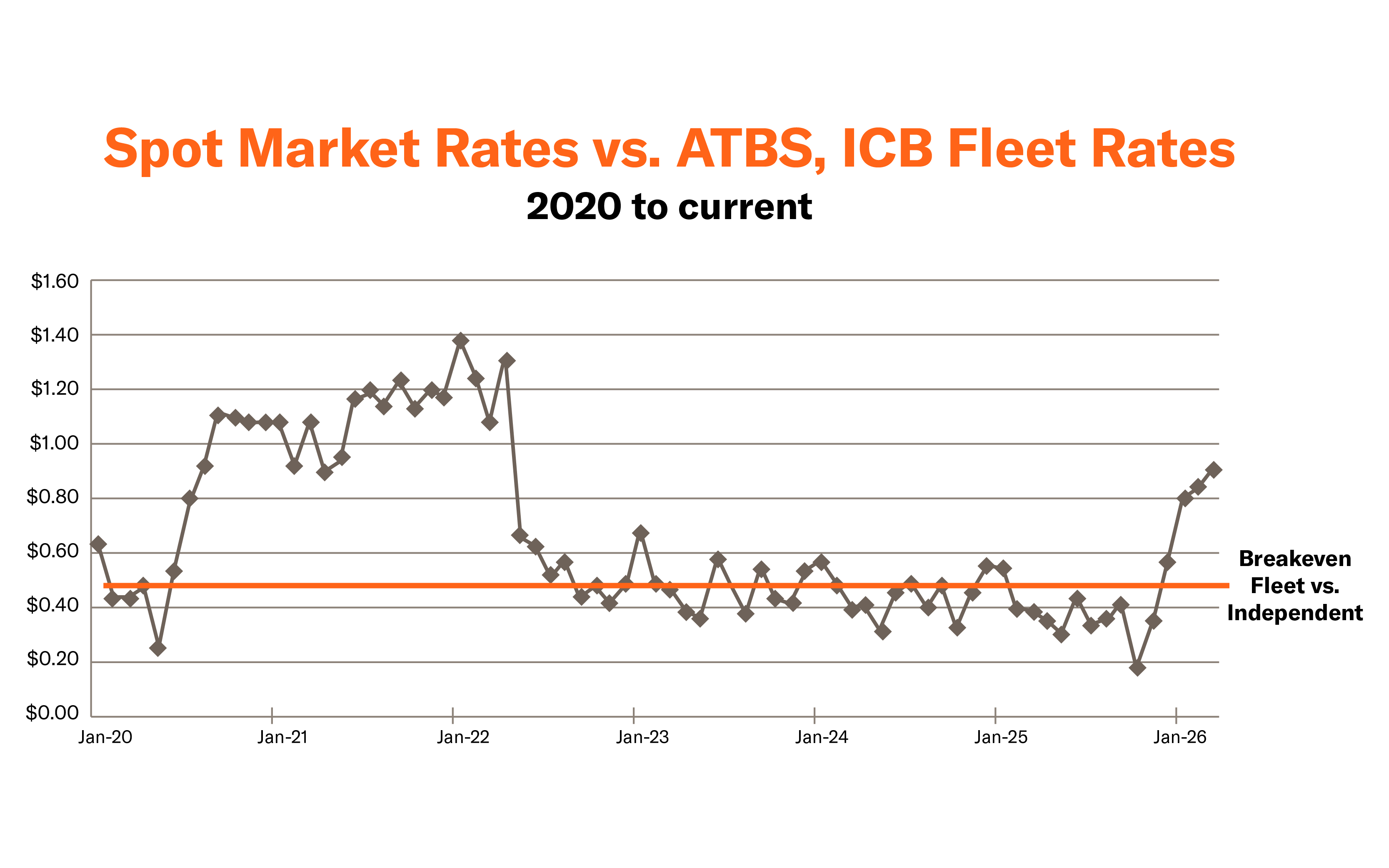
Data from American Truck Business Services (ATBS)
Freight market impact on owner-operators
The state of the freight market plays a critical role in determining:
- How many loads are available
- What rates shippers are willing to pay
- Who has negotiating power – carriers or shippers
Owner-operators are typically the most affected by these variables. Unlike larger fleets with more buying power and sway, owner-operators have less leverage.
Additionally, owner-operators who run under their own authority are usually more impacted by freight market shifts than owner-operators who do business with a carrier. This is because own authority owner-operators rely on the spot market and cover all of their operating costs, like fuel, maintenance and insurance. If fewer loads are available and rates are lower, owner-operators may have no choice but to drive more miles for less money.
Freight market cycles can either add to these challenges or create new opportunities:
- Soft markets are less beneficial for owner-operators: Shippers hold pricing power, which increases competition among carriers.
- Tight markets are helpful for owner-operators: Limited capacity drives rates up, leading to higher profitability for carriers.
Understanding these market dynamics is essential for owner-operators to adapt and stay competitive.
What are the benefits of being an owner-operator during market changes?
Many company drivers become owner-operators despite market ups and downs because they gain:
- More independence
- Increased control over the loads they haul and when they get home
- Potential for a higher revenue than the pay they made as a company driver
- Ability to specialize in equipment types or niche lanes
- Access to both contract and spot freight options
- Tax advantages and business deductions
- Opportunity to outperform fleets during tight markets
Top owner-operators succeed by managing costs and avoiding impulsive decisions during boom cycles.
What are the challenges of being an owner-operator during market changes?
Being an owner-operator isn’t easy. They often face many challenges, especially during market downturns, including:
- Thin margins with risk to cash flow
- High operating costs, even when freight rates decline
- Risk of poor market timing, such as buying trucks at unfavorable points in the cycle
- Potential for failure among new entrants, with cash management as the primary issue
When an owner-operator fails, it’s often due to poor cost awareness and bad timing, not a lack of driving skills.
How can owner-operators navigate a changing freight market?
To succeed, owner-operators should remember that they run a business now. They aren’t just hauling freight as company drivers.
Key strategies for success include:
- Understanding their cost per mile
- Learning how to find profitable freight to haul
- Selecting lanes and brokers with care
- Utilizing fuel discounts
- Planning for maintenance and downtime
- Maintaining cash reserves that are built during stronger market periods
- Diversifying their freight sources, including spot, contract and dedicated loads
- Assessing the market cycle position before making major business decisions
- Considering doing business with a carrier to take advantage of operating discounts, load boards and equipment options
What is the outlook on the freight market?
Most industry experts, such as NATSO, predict the following outlook for the freight market:
- 2026 should be a year of stabilization and early recovery.
- Capacity is tightening, though unevenly across lanes and equipment types.
- Rates may rise modestly, with seasonal and regional fluctuations.
- A true boom will likely need stronger consumer demand for goods, not just a reduction in carrier capacity.